HISTORICAL REPORT
The Eucharistic Miracle of Lanciano
 Ancient Anxanum, the city of the Frentanese, has contained for over twelve
centuries the first and greatest Eucharistic Miracle of the Catholic Church.
This wondrous Event took place in the 8th century A.D. in the little Church of
St. Legontian, as a divine response to a Basilian monk doubt about Jesus' Real
Presence in the Eucharist.
During Holy Mass, after the two-fold consecration, the host was changed into
live Flesh and the wine was changed into live Blood, wich coagulated into five
globules, irregular and differing in shape and size.
The Host-Flesh, as can be very distinctly observed today, has the same
dimensions as the large host used today in the Latin church; it is light brown
and appears rose-colored when lighted from the back.
The Blood is coagulated and has an earthy color resembling the yellow of
ochre.
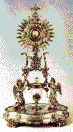
Since 1713 the Flesh has been reserved in an artistic silver Ostensorium, delicately embossed by an
artisan of the Neapolitan school.
The Blood is enclosed in a rich and very old cup
made of Rock-crystal.
The Minor Conventual Friars have been the custodians of the Sanctuary since
1252; their appointment was the wish of Bishop Landulf of Chieti; their
appointment was confirmed by a Pontifical Bull dated April 20th, 1252.
The church was in charge of the Basilian monks until 1176; from 1176 until 1252
the Benedictines staffed the church.
In 1258 the Franciscans built the present church.
In 1700 its architectural style was changed from romanesque-gothic to
baroque.
The "Miracle" was first reserved in a chapel situated at the side of the main
altar.
Then, from 1636 it was reserved in a side-altar of the nave wich still contains
the old iron chest and the commemorative
inscription.
In 1902 it was transferred into the present monumental marble altar which the people of
Lanciano had erected.
Various ecclesiastical investigation ("Recognitions") were conducted since
1574.
In 1970-'71 and taken up again partly in 1981 there took place a scientific investigation by the most
illustrius scientist Prof. Odoardo Linoli, eminent Professor in Anatomy and
Pathological Histology and in Chemistry and Clinical Microscopy.
He was assisted by Prof. Ruggero Bertelli of the University of Siena.
The analyses were conducted with absolute and unquestionable scientific
precision and they were documented with a series of microscopic photographs.
These analyses sustained the following conclusions:
- The Flesh is real Flesh. The Blood is real Blood.
- The Flesh and the Blood belong to the human species.
- The Flesh consists of the muscolar tissue of the heart.
- In the Flesh we see present in section: the myocardium, the endocardium,
the vagus nerve and also the left ventricle of the heart for the large
thickness of the myocardium.
- The Flesh is a "HEART" complete in its essential structure.
- The Flesh and the Blood have the same blood-type: AB (Blood-type identical
to that which Prof. Baima Bollone uncovered in the Holy Shroud of Turin).
- In the Blood there were found proteins in the same normal proportions
(percentage-wise) as are found in the sero-proteic make-up of the fresh normal
blood.
- In the Blood there were also found these minerals: chlorides, phosphorus,
magnesium, potassium, sodium and calcium.
- The preservation of the Flesh and of the Blood, which were left in their natural state for twelve centuries and exposed to the action of atmospheric and biological agents, remains an extraordinary phenomenon.
In conclusion, it may be said that Science, when called upon to testify, has given a certain and thorough response as regards the authenticity of the Eucharistic Miracle of Lanciano.
For information, books, pamphlets, slides, postcards, souvenirs of the Sanctuary, please apply to:
Santuario del Miracolo Eucaristico
Frati Minori Conventuali
66034 Lanciano (Ch), Italy
Phone +39 872 23289
Eucharistic Miracle Home Page
webmaster@cmns.mnegri.it
Consorzio Mario Negri Sud
Preserved from the Consorzio Mario Negri Sud historical website. The report and visitor information reflect their original publication. Some original illustrations are unavailable in this preserved copy.